Medical
Telehealth expansion welcomed but more needs to be done



Medical News: The Government has been consulting extensively with the AMA, RACGP, ACCRM, RDAA, and other key peak bodies and members of the medical profession, to ensure Medicare is responsive to the challenges of COVID-19.
The Government is also consulting with the AMA, RACGP, ACCRM, RDAA and other critical parts of the medical profession during the course of this week to further expand our telehealth response.
The co-design will look to the best practise expansion of telehealth items for all patients, with or without COVID-19, to see any general practitioner or medical specialist during the COVID-19 health emergency.
From 23 March, the Government will enable all vulnerable general practitioners and other vulnerable healthcare professionals who are currently authorised to use telehealth item numbers, to use telehealth for all consultations with all their patients.
Register FREE and join 20,000+ industry professionals who receive the latest industry news, innovations and insights from Health Industry Hub; the ONLY one-stop-hub connecting Australia’s Pharma, MedTech and Biotech industry professionals.
This includes healthcare providers who are:
- Aged at least 70 years old.
- Indigenous and aged at least 50 years old.
- Pregnant.
- A parent of a child under 12 months.
- Immune compromised.
- Have a chronic medical condition that results in increased risk from coronavirus infection.
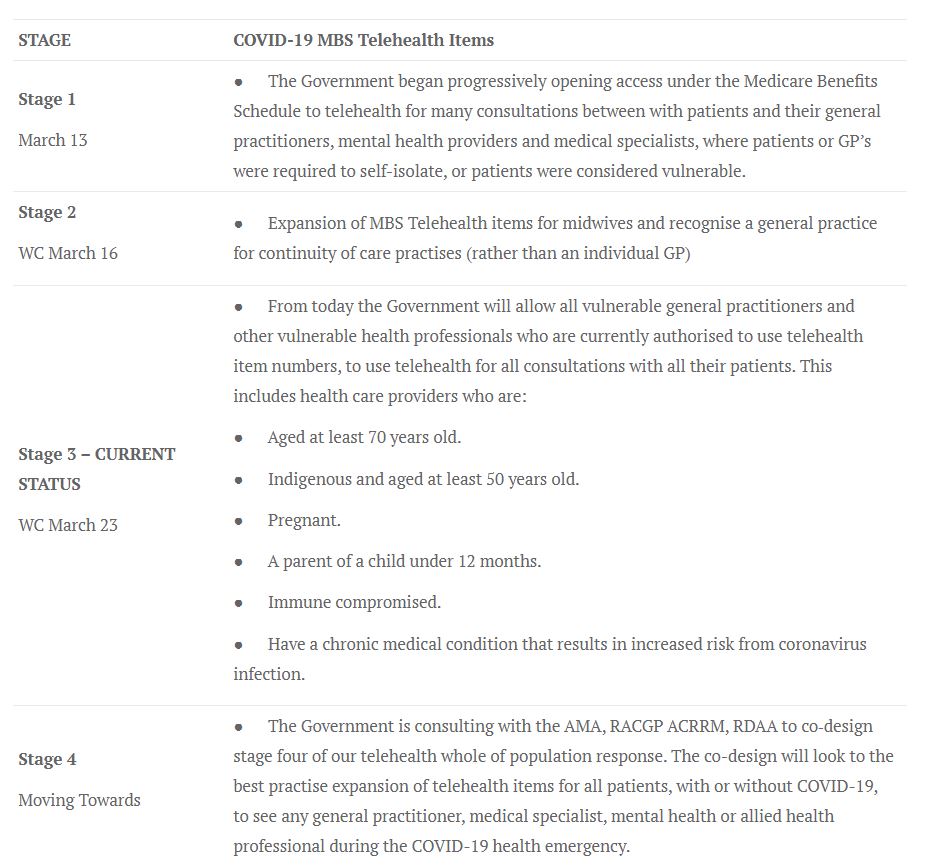
The National Rural Health Alliance, the peak body for rural and remote health in Australia, has welcomed the Australian Government’s expansion of telehealth Medicare item numbers but has called for access to be expanded as soon as possible to all health professionals.
“Allowing more people to have consultations with their GP or health professional at home, whether for COVID-19 or something else, is a sensible move that will save lives,” said CEO Dr Gabrielle O’Kane.
“But we need to see the Australian Government move as soon as possible to ‘stage 4’, which will allow any patient to see any health professional, including allied health professional, for any reason during the COVID-19 pandemic.
“This is particularly important for people in rural Australia where access to health care is more difficult and there are often fewer health professionals, so it’s particularly important that these health professionals can see patients without the risk of getting sick.”
Dr O’Kane warned that if telehealth was going to become more widespread, it’s essential to improve internet connectivity in rural Australia.
“Rural Australia often has poor connectivity at the best of times. With the rapid expansion of telehealth brought on by COVID-19, NBN Co and the Government must ensure that people in all parts of Australia can access these services.
“This should include not only improving connectivity and internet infrastructure in rural Australia, but also working with retail service providers to ensure that internet and data packages are affordable and accessible for everyone.”
Digital & Innovation

Medical drone to reduce health equity gaps in rural and remote Australia
A specialised medical drone which increases accessibility to essential health services such as pathology, medicines, and telehealth services in rural […]
MoreNews & Trends - Pharmaceuticals

We’ve spent more on healthcare, but it’s been worth it
Healthcare expenditure is surging, with Australia now allocating approximately one-tenth of its budget to this sector. This financial uptick prompts […]
MoreNews & Trends - Pharmaceuticals

New partnership to raise the bar in precision oncology in Queensland
Pharma News: The Australian Translational Genomics Centre (ATGC) is teaming up with non-profit research organisation Omico and the PrOSPeCT program […]
MoreNews & Trends - Biotechnology

AusBiotech appoints new CEO: Former Sanofi corporate affairs and sustainability leader takes the helm
Biotech News: AusBiotech, the nation’s leading industry body for the biotech sector, has named former leader at Sanofi, Rebekah Cassidy, […]
More